

 ReachExtra
Iván Merino, Jimena: Drone Racing Champion
His passion is flying, flying in all of its forms: paragliding (his father was a Spanish paragliding champion); remote control airplanes; and more recently, drones; small four-propeller, unmanned aircraft, which are remote-controlled and can reach high speeds.
Iván Merino is ready for a new challenge, although he already has an extensive list of victories since he discovered the exciting world of drones two and half years ago.

He is currently ranked number one in Spain, having won the Andalusian championship in 2017 and finished second in the World Championship held in Seville that same year.
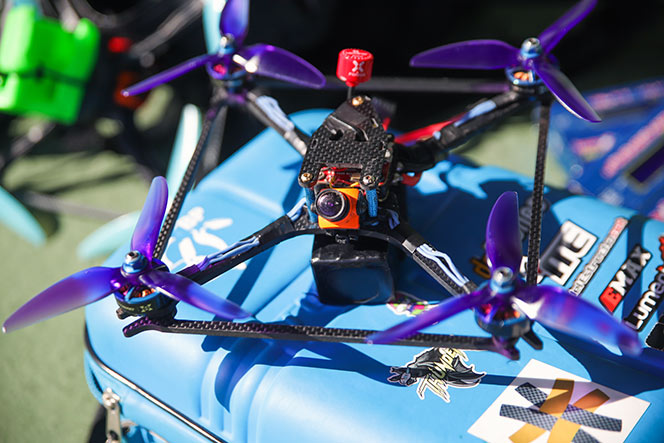
The victories were very important for him because he achieved a contract with a sponsor, Allcomposites, which has allowed him to compete throughout the country in 2018.
Last November, Merino was part of the Spanish team that competed in China against 160 pilots from all over the world.

He had no luck in the individual heats but overall, he won the first two races and finished second in the third one. Spain came eighth, which disappointed him.
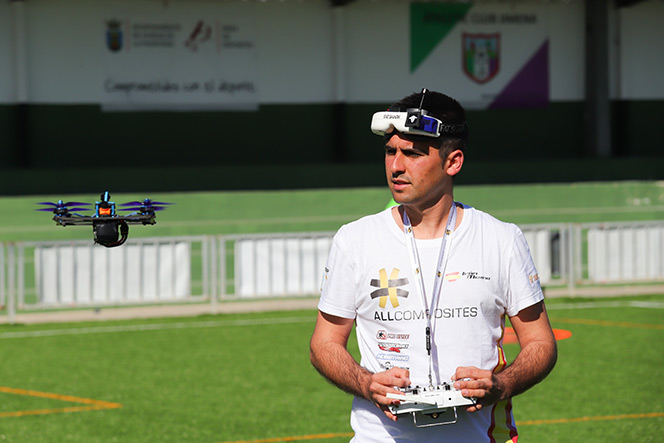
We met Merino at the Jimena football field. The drone racing champion placed a number of obstacles throughout the AstroTurf which he would then navigate his drone through, at a dizzying speed directed by sophisticated controls and a pair of goggles that allow him to manoeuvre the drone as if he were piloting it from inside.
Iván Merino controls his drones with an unquestionable ability. The drone glides up and down and even dances around the pilot in a harmony that would surprise anyone who is unaccustomed to such displays.
This all started because of a present his mother gave him. This former student of Aerospace Engineering at the University of Cádiz remembers his first remote-controlled plane when he was five years old, “my mother would give me anything I wanted as long as I didn’t get into paragliding, in which my father is a former Spanish champion, but I like everything that flies.”
He has a classmate to thank for his drone addiction… “he sold me his drone for 20 euros and introduced me to the world of drone racing. Maybe my victories have come because I was already used to flying my planes with camera and goggles, so even though drones are different, I was able to quickly learn how to use them.”
His passion is flying, and to participate in races where, after qualifying stages that last only a few minutes, six drones compete for first place. The pilots sitting in the stands, who are protected by a net, can feel the vertigo of the competition running through their veins.
Behind all this, is a passion for this sport that is brings him so much satisfaction. Whenever he gets the chance, he trains in Pinar del Rey, where he controls his drones with incredible skill.
“I’m having a great time. Flying has always been my passion, one way or another, but with drones I am able to travel, compete, and even do reports, like one that I have coming up in with the great Kitesurf champion, Gisela Pulido.”
Merino recommends to anyone wanting to learn this sport to practice on simulators first, these can be found online, before buying their first drone.
He also recommends safety measures and common sense measures when using these incredible devices, “it is common sense that you should only fly in places where there are no people nearby, in the countryside, for example, and never near an airport. The regulations that we have are not well defined yet, they have still to be perfected, but it is not a dangerous activity – in five years there hasn’t been an accident.”
What is a drone
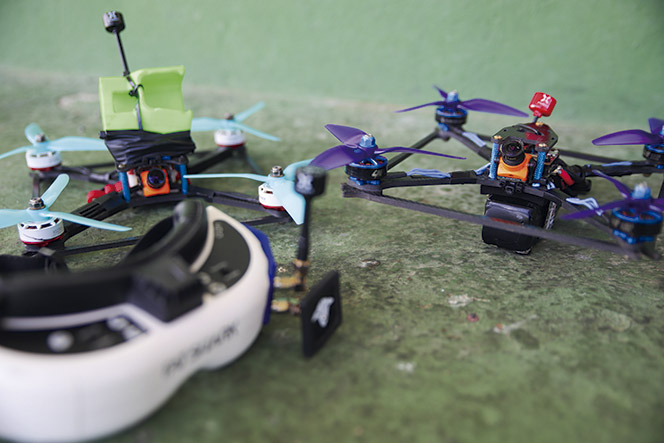
A drone is an unmanned aerial vehicle (‘VANT’ is the acronym in Spanish) that can be controlled remotely.
At present, it has different functions to its commercial purposes in search and rescue missions.
Drones have, in addition to competitive sport uses, multiple other uses such as filming and photographing sporting events from different angles, in emergency situations during searches for missing people, construction control, surveillance at borders, pest threat location, control of forest fires, archaeological research, biological research, geological purposes, and even for handling harmful materials that can be dangerous for humans.
A fascinating world that has only been around for about five years.
