

 ReachExtra
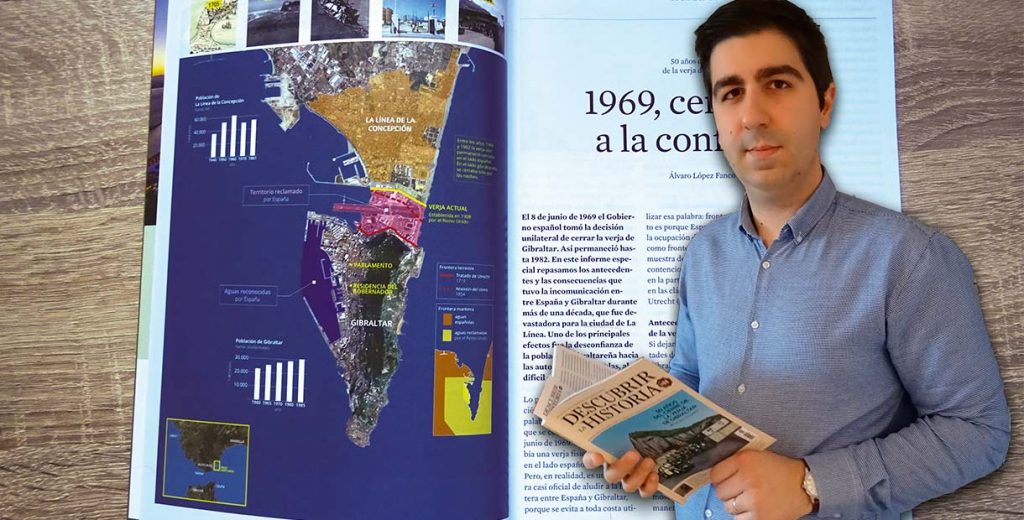
Álvaro López, Descubrir la Historia Magazine Interview
“Understanding the consequences of past decisions should help us avoid repeating what doesn’t work”
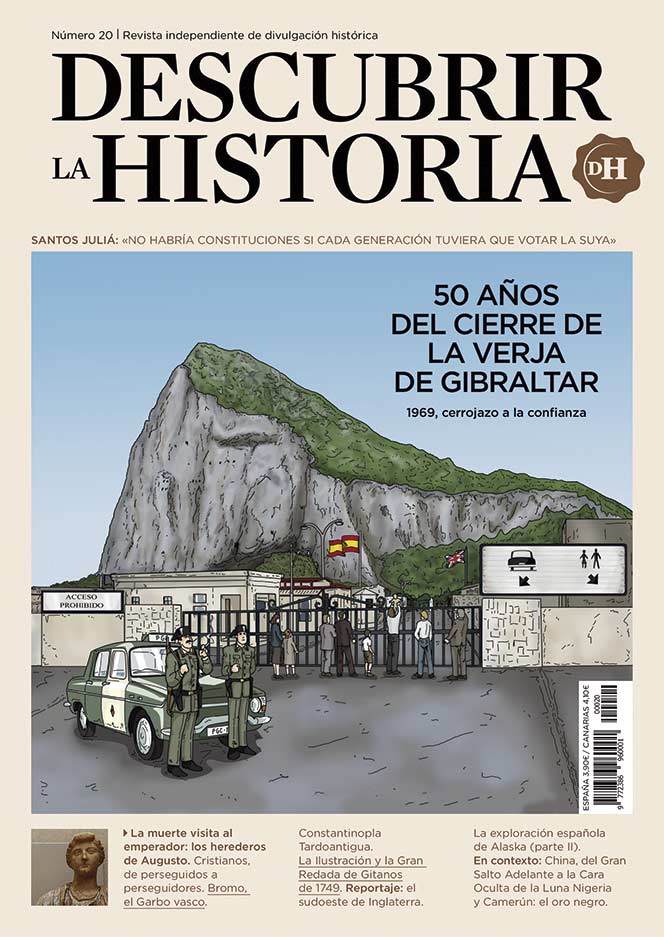
The 20th edition of ‘Descubrir la Historia’ has just been released; a courageous national publication, the current issue of which is focused on the 50th anniversary of the closure of the Gibraltar Frontier.

When was the magazine created?

The magazine was born on the 28th of December 2013 as a website with no clear direction. Soon enough, we realized that a lot of people were interested in what we were publishing and we thought about launching a print publication. Initially, this magazine was funded through a crowdfunding campaign.
The first issue came out in April 2015 and was published on a quarterly basis. We only sent it to subscribers, and it was in black and white, and the design was poor compared to the current one.
What was the idea behind the magazine?
I come from the world of journalism, and the magazine was conceived by Miguel Vega Carrasco (historian) and myself. Gala Yagüe Narváez (an art historian) joined soon after. Although the team is different today; people have come and gone, we always share the same motivation: to create a high-quality publication targeted towards the general public.

Another goal is to combat the ‘pseudo-dissemination’ of information; that is, articles based on dubious theories which tend to have a very clear intention, sometimes political and other times banal(click-bait, for example).
Have the initial goals been accomplished?
We are well past our initial goals. The project was born with no clear mission statement beyond writing about what we enjoy, and doing so accurately. Getting the magazine out on paper, and not only that, but being able to distribute it throughout Spain and, on top of that, export it to several countries, is much more than we expected.
What is your criteria for getting each edition out?
We usually plan what we’re going to publish well in advance. We always try to find a balance between the different periods of history, so that readers with a predilection for one of them may end up taking interest in other periods that they may not be that familiar with. We used to ask for originals, but now we tend to receive a lot of proposals and select the right ones precisely on that basis: to ensure each issue is balanced.
Would it be fair to say this magazine is a crazy idea that happened to work?
More than a businessman, I am a passionate editor. Therefore, to have published 20 issues of the magazine, each one better than the previous one (we have redesigned it, incorporated sections, increased the number of pages, improved the paper, etc.) feels like a great success. Maintaining it over time will depend, above all, on having enough subscribers and readers supporting us.
What about your Online presence?
During the summer of 2018, we launched a new crowdfunding campaign, similar to the one we launched to publish the first issue. This time, we wanted to fund apps for iOS and Android, so that subscribers could read the magazine on their mobiles. At the same time, we uploaded all the magazines’ contents to the website, though not all of them are accessible to all visitors. A lot of the articles are only available to subscribers.
In this way, we provided an additional service for subscribers (at no extra cost), to encourage more people to join (and this is happening already). In addition, we created an exclusive digital subscription, since many of our followers on social networks – especially Facebook – follow us from Latin America, where we don’t offer a paper subscription.
Do you think the magazine has been as successful as expected?
The launch of the magazine in the national market was a bittersweet moment. We expected that sales could exceed 50% of the distribution, but very soon the distributor (SGEL) told us that this was almost impossible for any magazine, especially a new one.
So right now, we have reached between 30 and 40% of distribution sales in Spain (not counting subscriptions, which are about 400 at the moment), to which we need to add what is distributed to other countries. So, it has actually been a successful launch.
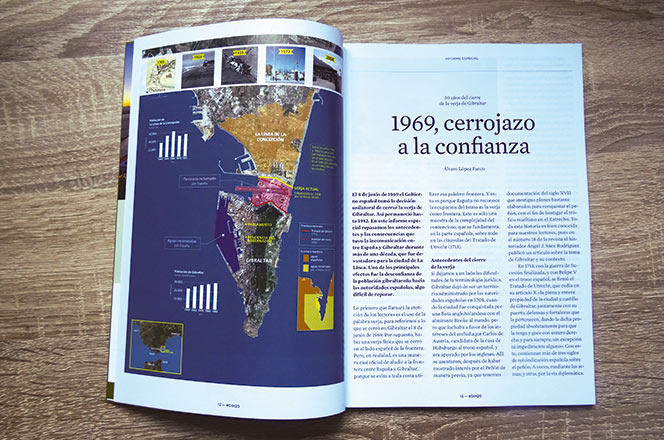
This last issue pays special attention to the 50 year anniversary of the closure of the Spain-Gibraltar frontier
The closing of the frontier was a terrible event for the Campo de Gibraltar, especially for La Línea and Gibraltar. As explained in the article, which constitutes the special report of the 20th issue of the magazine (May-June 2019), it meant a significant loss of population for La Línea, with many people losing their jobs and having to go elsewhere in Spain. The economy was seriously damaged on both sides of the border.
And we still haven’t mentioned the emotional aspect, which should never be overlooked. The closing of the frontier separated friends and families, in addition to that painful feeling of impotence of having to travel many kilometres and crossing the Strait to go to a place that, in reality, is only at a few metres distance.
The only thing that allowed the Campo de Gibraltar to stay afloat was the industrial development of the entire bay, which in turn allowed the port to increase its activity. Today we stand in the shadow caused by Brexit, and knowing the consequences of past actions should help us avoid repeating what doesn’t work, and what only favours the distancing between neighbouring communities.
Gibraltar and the Campo de Gibraltar have a strong historical ‘imprint’. Do you think, as neighbours, that people on both sides are familiar enough with it?
From my point of view, it is not sufficiently studied by the non-specialist public in general terms, but there is a very extensive historiographic work and a great deal of high-level research that has gone into the history of the Campo de Gibraltar.
We need to emphasize the work of the Instituto de Estudios Campogibraltareños (Institute of Campo de Gibraltar Studies), which, for decades, has been bringing together the best specialists in Almoraima in its study sessions, meaning the history of the region has been studied extensively, although there is still a lot to be done.
So, I think that a good dissemination is needed, and this can only be properly achieved when all agents (public and private institutions, media and schools) realize what we have in our region.
All this can only have a very positive impact. And I’m not only referring to the Campo de Gibraltar, but to Gibraltar, where there are also excellent researchers and activities of great relevance, such as those organised at the Garrison Library. But there is always room for improvement, and this is something I think our neighbours would encourage.
Álvaro López, Descubrir la Historia Magazine Interview
