

 ReachExtra
The 8th largest university in the United Kingdom held an exhibition dedicated to the source of life on Earth in Gibraltar’s hub of art and theatre, the John Macintosh Hall.
The University of Central Lancashire (UCLAN), in collaboration with NASA, created an awe inspiring video of the rotation and, surprisingly, the seven different colours of our star that are not processed by the human eye.
Professor Robert W. Walsh, Professor of Solar Physics at UCLAN, explained: ‘The sun gives off light from all parts of the electromagnetic spectrum. We only see a part of the sun known as the photosphere, which gives off a white-yellow colour. But there are other parts of the sun we don’t see…’

Images shot by NASA’s Solar Dynamic Observatory, a ‘space-based sun watcher’, are ‘painted’ over using filters so that astronomers can immediately know which part of the sun is being observed.
Each colour represents the wavelengths of ‘Extreme Ultraviolet’ (EUV) light being examined, as well as temperature and materials present.
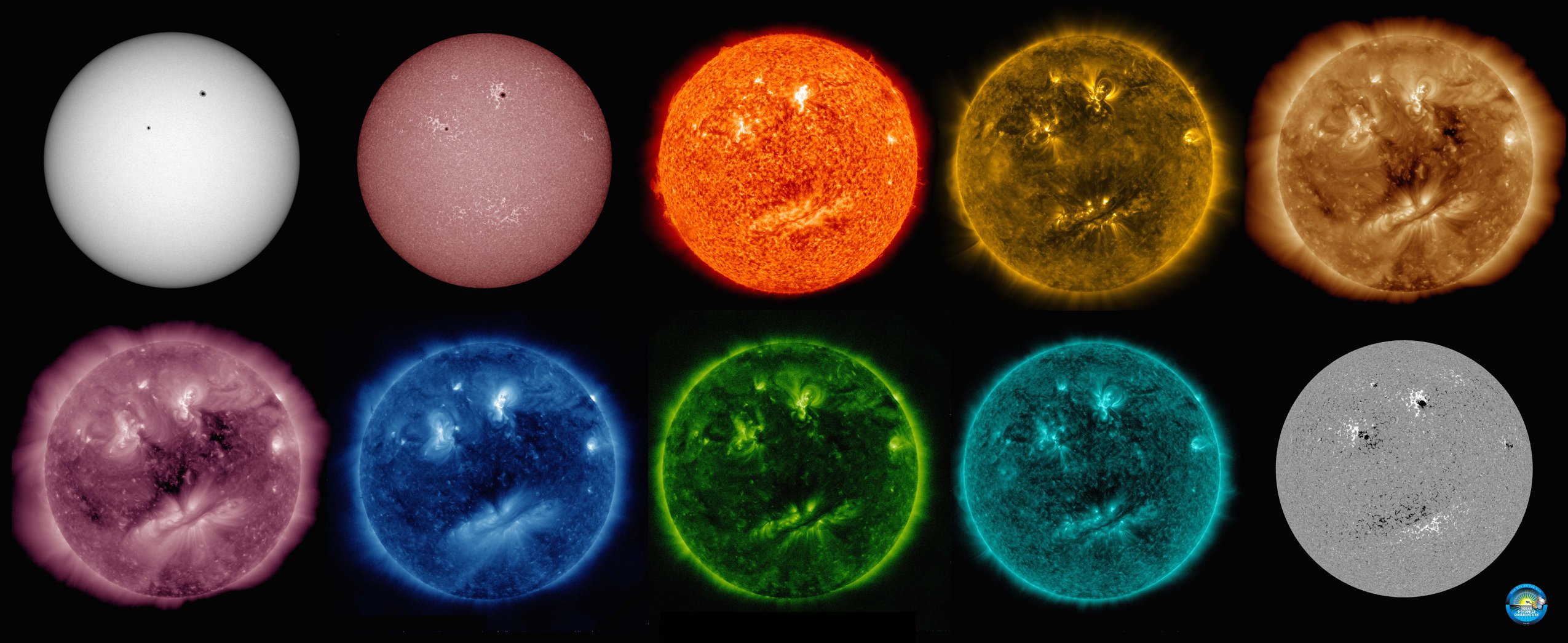

The red filter shows the ‘chromosphere’, one of the three main layers of the sun, approximately 3,000-5,000 km deep, and represents the EUV light emitted by the element Helium.
The temperature we are seeing with the red filter is 50,000 degrees Kelvin, which is 49,725 degrees Celsius. The hottest representation is coloured teal which is 9,999,726.85 degrees Celsius.
The other 6 filters display the ‘corona’ of the sun, which makes up its outer atmosphere, and all arise from the element iron.
In temperatures beyond a million degrees Celsius, iron becomes an electrified gas called plasma. As the temperature increases, more electrons are ripped from the iron atoms to form iron ions in different states of ionization.
All this together presents us with a magical 7 colour depiction of the sun.
‘You could view what we have here as an art installation, we’ve set up a gallery in the John Macintosh Hall; the centre of Gibraltar’s culture. We’re using images of the sun as a way of portraying it as art, with a beautiful sound track to stir people’s emotions.’
‘This is a much better way that people can engage with, what would otherwise be raw data and numbers’ said Professor Walsh.
An artistic and technical masterpiece; each frame that makes up their 18 minute video is a single photo, one photo taken at one hour intervals and stitched together to create an awe inspiring time-lapse of the true nature of the sun; it’s rotation as well as it’s huge solar flares, many times larger than the size of Earth, bursting out from the sun and being sucked back in by gravity; creating extremely massive flowing rings and semicircles.
Professor Walsh explains the importance of studying our sun:
‘The sun has an activity cycle, every 11 years or so it goes from quiet and clam to very magnetically angry; erupting in solar flares and solar storms that sometimes head towards Earth.’
‘When a large solar storm hits, it creates wonderful Aurora Borealis, but also some malevolent reactions as well. They can short circuit satellites, causing them to fall out of their course.’
‘It can also increase the radiation levels astronauts experience on the International Space Station (ISS), so they would need to deploy a shield to protect themselves.’
It’s not only astronauts and satellites that
can be affected;
‘Airlines, particularly flying over the Atlantic, would need to fly at lower altitudes during a solar storm to reduce radiation affecting their passengers and crew.’
This exhibition is also part of UCLAN’s outreach to get more adults and children interested in studying the sun. The university boasts a highly advanced observatory with telescopes, one of which they invested over a quarter of a million pounds, to allow students to study galaxies and stars.
Find out more about degrees at UCLAN
This post was created with our nice and easy submission form. Create your post!
