

 ReachExtra
In 1996, when I was in charge of the InterCar Gibraltar maritime coal terminal in Los Barrios, owned by the Sevillana electricity company, we went to Madrid to participate as exhibitors at the CoalTrans International Coal Fair.
Just in front of us in the exhibition hall there was a stand with the acronym ARA, the initials for the ports of Amsterdam, Rotterdam and Antwerp. I was struck by how these three ports which are fierce competitors among themselves within the solid fuel bulk sector shared the same exhibition space.
On expressing my perplexity to them, they replied that, although these were three competing companies, they preferred to team up while abroad – as the ARA brand – because it has proven more effective than when they had exhibited separately.

The above is not the only example of neighbouring ports from different countries collaborating with each other.

The British port of Dover on the English Channel, hosts a permanent French customs office and on the other side, the French port of Calais has its own English customs’ office, making the passenger’s crossing from one country to another smoother; United States customs officers, among others, are stationed in the port of Algeciras, to perform pre-shipping controls on containers destined to their countries; the ports of Copenhagen in Denmark and Malmö in Sweden share the same Port Authority.
Does it make sense that, within a distance of just sixteen nautical miles, and only two hours of travel, passengers who cross the Strait of Gibraltar from Algeciras to Tangier or vice versa, pass through two controls?

Or that trucks covering this route are stopped twice, opened twice and have their merchandise inspected twice? Wouldn’t it be easier for everyone involved to undergo just one, joint inspection from the customs authorities of both countries, at the port of origin?
I am firmly convinced that, on the Strait of Gibraltar, the port of Algeciras wouldn’t have as many shipping containers as it currently does were it not for the port of Tánger Med, and the Tánger Med port wouldn’t have as many shipping containers as it currently does were it not for the port of Algeciras. The same could be said of the bunkering between the ports of Algeciras and Gibraltar.
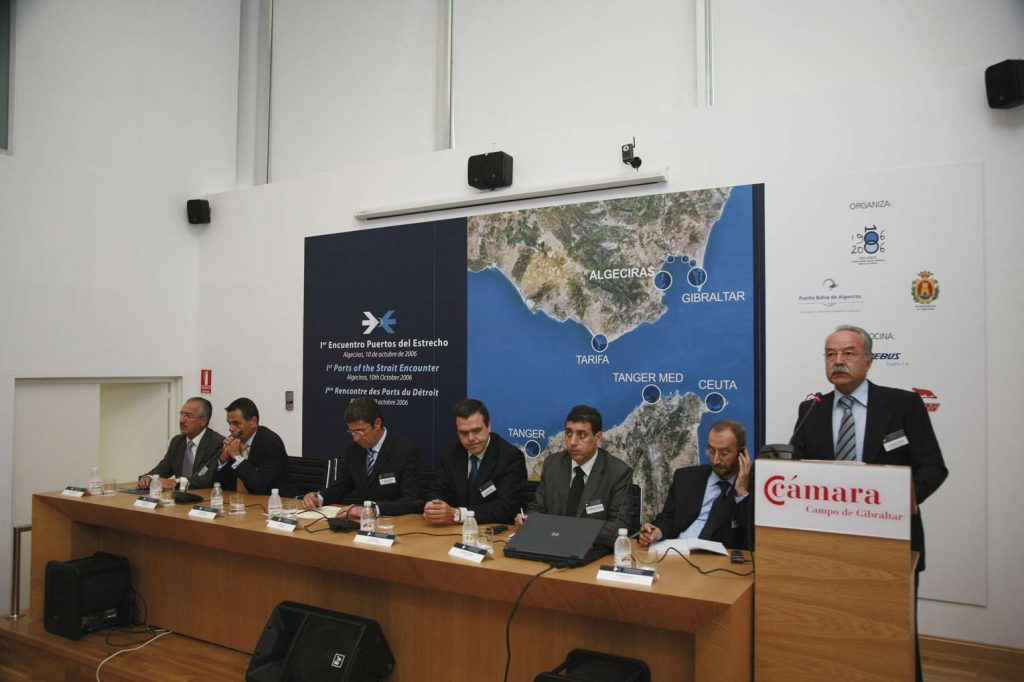
What really gives value to the ports of Ceuta, Tangier-City, Tangier Med, Gibraltar, Tarifa and Algeciras, is their enviable geostrategic position in the Straits of Gibraltar, and it’s precisely their combined great sea port potential that makes each of them powerful and important.
Inspired by this belief and these principles, the representatives of all these ports and their respective Chambers of Commerce convened in Algeciras on the historic day of October 10th, 2006, and analysed maritime and port issues in the fields of security, environment, trade and other common areas of interests for the respective ports and their port communities.
Following these meetings, we encouraged the ports across the shores to continue this important initiative but, unfortunately, there has not been a meeting since.
The seas, without limits or borders, have always served as an agent for expanding great civilisations. However, as Iva Zanicchi once sang in a beautiful melody: at times, the waves turn into frontiers and the shores are dyed in different colours.
We should not allow sovereignty issues or the unjustified misgivings of misunderstood competition between our ports to spoil the enormous potential of the Strait of Gibraltar brand.
