

 ReachExtra
Algeciras Astrophysicist Javier Peralta Studying Venus to Understand Greenhouse Effect on Earth: “A better knowledge of Venus’ atmosphere can help us better understand the greenhouse effect on Earth”
Astrophysicist Javier Peralta from Algeciras has been working in the Japan Arerospace Exploration Agency’s (JAXA) ‘Akatsuki Mission’ for nearly 5 years now
“We need to study Venus to learn more about the greenhouse effect, an effect which we have already began to suffer here on Earth, and find out what would be the point of no return after which nothing more could be done.”

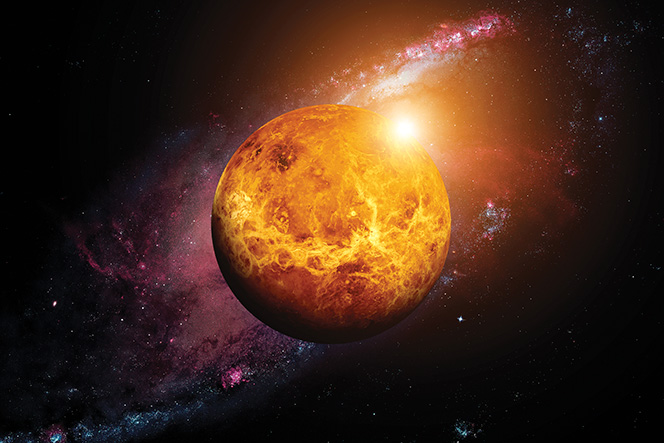
The astrophysicist Javier Peralta’s eyes visibly glow when he talks about the Akatsuki Mission (‘Dawn mission’) and the task that, for some time now, has become his research specialty: the observation and analysis of the sky over Venus.
Native to Algeciras, Peralta has been living in Japan for almost five years, working for the Japan Arerospace Exploration Agency after being awarded one of the most prestigious international scholarships (“a dream come true”).
He still doesn’t know what the future will hold for him when his contract comes to an end. “I would like to return, if not to Spain, at least to Europe, so I can be closer to my family. I have been living the nomadic life for too many years already. But it is complicated for us researchers: research has become ‘uberized’, with a small number of short term contracts… It is a sad situation.”

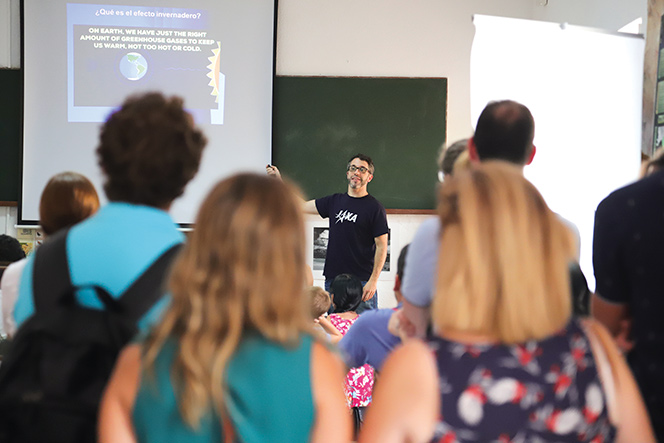
Javier Peralta’s passion for our neighbouring planet goes way back and was consolidated during his years of work on the European Space Agency’s (ESA) Venus Express mission (which culminated in 2014). Before that, he studied Astrophysics at the University of La Laguna (Tenerife), started his doctorate in Bilbao and worked with data from ESA’s Mars Express and NASA’s Galileo and Messenger missions.
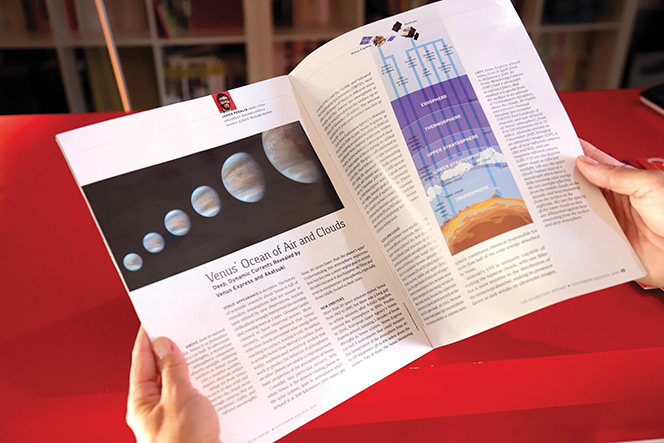
“The peculiarity of the Japanese space mission, which entered orbital insertion around Venus in December 2015, is that it’s cameras can capture the different levels of clouds existing in the Venus atmosphere, studying a very specific phenomenon of this planet: atmospheric superrotation”, explains Peralta, who has just published an extensive article on Venus’ “ocean of air and clouds” in the prestigious journal The Planetary Society.
He is convinced that dissemination is essential for the advancement of scientific knowledge although, unfortunately, some specialist publishers intend to “turn it into a walled garden subject to payment of an entrance fee which is only within the reach, of institutions and universities – whose funds are reducing all the time.”
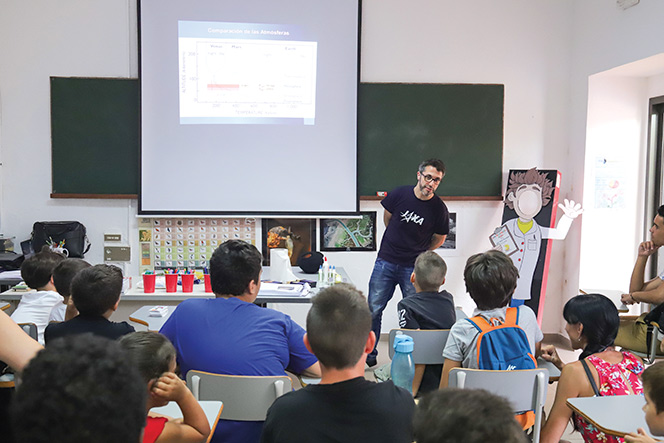
During his short break in Algeciras, where he also had time to give a lecture as part of the Diverciencia series, the specialist in atmospheric dynamics explains that “Venus has very strong winds of more than 400 kilometres per hour; its atmosphere spins at about 60 times faster than the surface of the planet, and we still do not know why… This is the mystery the Akatsuki Mission is trying to solve.”
He adds that “the phenomenon of superrotation occurs not only on Venus, but also on Titan (one of Saturn’s moons) and on many exoplanets known as ‘Hot Jupiters’ because they are approximately the size of Jupiter and very close to their stars in their respective solar systems, with enormous temperature differences between day and night.”
This alone would justify any new mission to Venus (because it allows us to deepen our knowledge of the universe). India is planning the Shukrayaan-1 mission for 2023 and there may be another European mission, ‘EnVision’, around 2032. But, according to Peralta, the biggest attraction is how the study of Venus’ enormous greenhouse effect – the biggest in the entire solar system, as confirmed by the famous Carl Sagan in his doctoral thesis – can help us here on earth.
“When we observe Venus in the sky at night, it seems to be the brightest of the stars… This is because it reflects a lot of light and, consequently, absorbs very little of the Sun’s light. It should be a dark, cold planet, and yet its surface is much warmer than we thought, with a temperature of about 450 ºC. The main cause of these temperatures is the high levels of carbon dioxide that exist in its atmosphere.”
According to Peralta, 98% of Venus’ atmosphere is currently made up of CO2, which prevents radiation escaping into space so that it returns to the surface, producing a brutal overheating effect.
The challenge, according to the Algeciras scientist, is to find out “what happened in Venus to make the greenhouse effect soar, and what we can do on Earth to prevent climate change from leading us to the same fate, and to avoid reaching the point where the greenhouse effect is irreversible.”
Algeciras Astrophysicist Javier Peralta Studying Venus to Understand Greenhouse Effect on Earth: “A better knowledge of Venus’ atmosphere can help us better understand the greenhouse effect on Earth”
